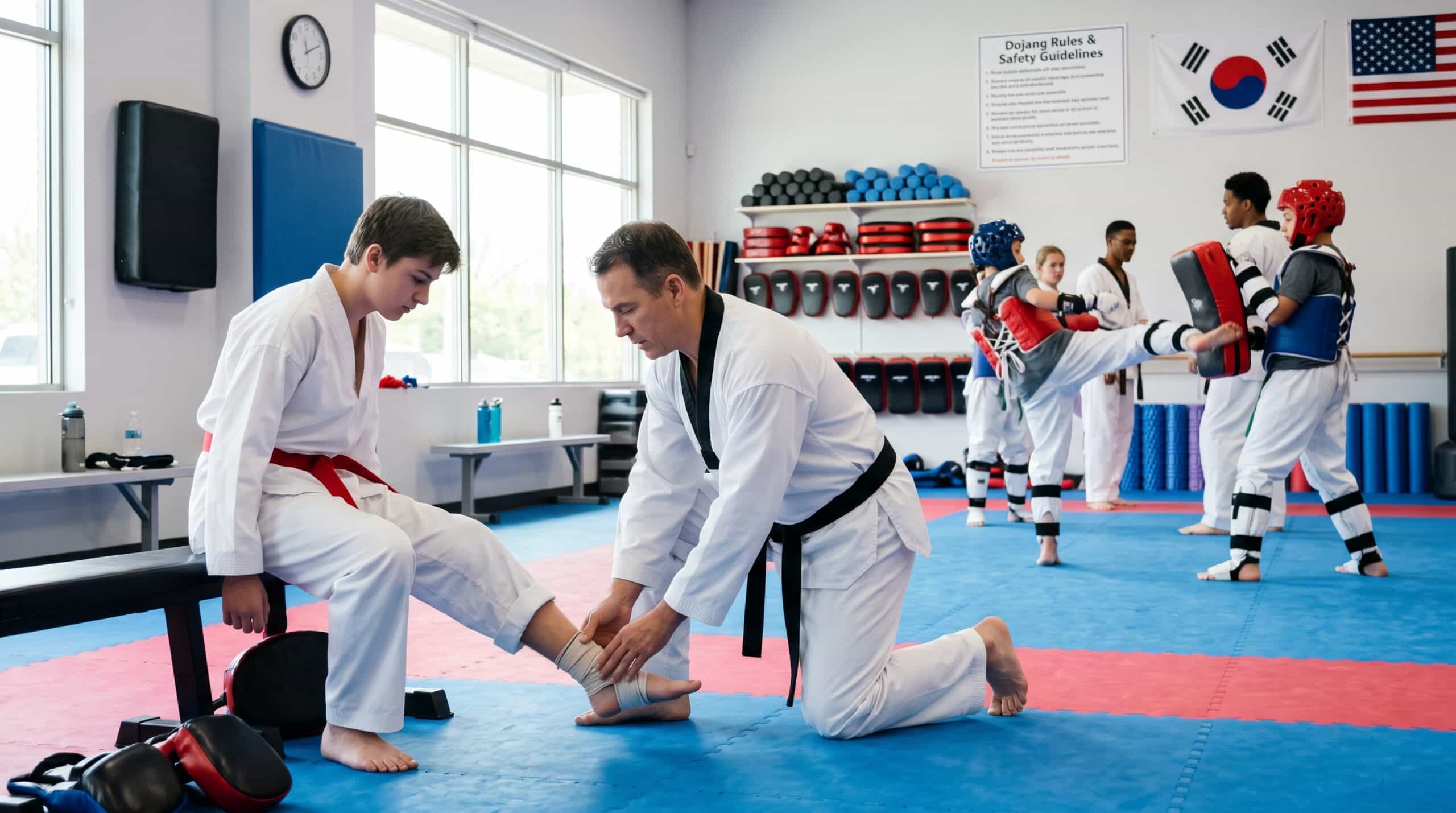
Taekwondo injuries mostly hit the lower body: bruised and broken toes, sprained ankles, foot injuries from kicks that land on elbows or knees, and knee and hip strain from high, fast kicking. Head kicks cause fewer injuries but the most serious ones, so concussion awareness, contact rules and fitted gear matter more than anything else on the mat.
For a school owner, every one of those injuries is also a possible claim. This guide covers the common taekwondo injuries, sparring safety, head kicks, flexibility work and kids’ classes, plus which coverage usually responds when a student gets hurt. It’s about risk and operations, not medical advice. Anyone hurt in class should see a doctor.
What is taekwondo, and why does it injure the lower body?
Taekwondo is a striking art built around kicks: spinning kicks, jumping kicks, roundhouse kicks to the body and head, and fast footwork. Students train forms (poomsae), basics, sparring and breaking. Because kicks drive almost everything, feet, ankles, knees and hips take most of the load.
That’s the key difference from punching arts. In taekwondo, the foot is both the weapon and the thing most likely to get hurt. Students land kicks barefoot, pivot hard on the support foot and stretch hips to reach head height.
What are the most common taekwondo injuries?
The most common taekwondo injuries are bruises, sprains and fractures of the foot and toes, ankle sprains, knee strain, hip flexor and hamstring pulls, and bruised forearms from blocking. Head injuries are less common but the most serious.
- Feet and toes. Kicks that land on a blocking elbow or knee, toes jammed on the mat, and spinning on a sticky floor.
- Ankles. Rolling on landing after a jumping kick, or pivoting with the foot planted. An ankle sprain is one of the most common reasons students miss class.
- Knees. Twisting on the support leg during roundhouse and spinning kicks.
- Hips and hamstrings. Pulls from high kicks thrown cold, or forced flexibility drills.
- Forearms and hands. Bruising from blocks and from breaking.
- Head and face. Head kicks in sparring, and collisions when two students kick at once.
What causes taekwondo foot injuries?
Taekwondo foot injuries usually come from kicking into a hard target: a partner’s elbow, knee or shin, or a poorly held board. Toes also get caught on mat seams and jammed during fast footwork.
Foot pads help but don’t remove the risk. Teach students to kick with the right striking surface for each kick, and to pull the toes back. Check mats for split seams and raised edges, since barefoot arts punish bad flooring. Broken toes look minor but often need care; a student with swelling, bruising or pain on weight bearing should stop and get it looked at.
How do you keep taekwondo sparring safe?
Keep taekwondo sparring safe with a set contact level, full fitted gear, matched partners, short rounds and an instructor watching every round. Most sparring injuries come from mismatches and lost control, not from the kicks themselves.
Taekwondo sparring safety checklist
| Area | What to require | Why it matters |
|---|---|---|
| Gear | Headgear, chest protector, forearm and shin guards, foot pads, mouthguard, groin protection | Cuts most bruises, cuts and fractures |
| Fit | Gear sized to the student and checked before rounds | Loose gear slips and exposes the head and shins |
| Pairing | Match by size, age, experience and attitude | Mismatches cause the worst injuries |
| Contact level | Announce it before each round | Students know what’s allowed |
| Head contact | Controlled or none, set by level and age | Head kicks cause the most serious injuries |
| Round length | Short rounds with rest | Tired students lose control |
| Supervision | Instructor on the floor, stop signal enforced | Someone ends a bad round fast |
Space pairs apart so spinning and back kicks don’t hit a neighbor. Clean shared gear and replace cracked or flattened pads. Our post on training and sparring coverage explains what policies expect from schools that spar.
What should school owners know about head kicks in taekwondo?
Head kicks in taekwondo are the most likely technique to cause a concussion, so control them by level and age, and pull any student with concussion signs for the day. Headgear reduces cuts and bruising but doesn’t prevent concussions.
Set clear rules for head kicks taekwondo students can throw:
- Beginners: no head contact. Kicks to the head stop short or aren’t allowed.
- Intermediate students: light, controlled contact with headgear, only when the instructor allows it.
- Kids: no head contact in sparring.
- Anyone: a student who takes a hard kick to the head stops sparring for the day.
Teach every instructor the signs of a concussion: headache, confusion, dizziness, nausea, blurry vision, trouble with balance, or a student who just “isn’t right.” The free concussion training for coaches takes about an hour. A student with any of those signs needs a doctor’s clearance before returning to sparring.
Is hip flexibility work risky?
Flexibility work is safe when it’s gradual and warm, and risky when instructors force splits or push students’ legs. Hip flexor, groin and hamstring strains are common in schools that rush high kicks.
Warm up before stretching. Let each student work to their own range. Avoid partner stretches where one student pushes another’s leg; that’s a hands-on technique and a common source of claims. Build head-height kicks over months, not weeks. For more on building these habits into policy, read why martial arts studios are rewriting their injury prevention policies.
How should you run kids’ taekwondo classes safely?
Run kids’ classes with no head contact, fitted gear, size-matched partners, short rounds, low ratios and two adults in the room when possible. Most kids’ injuries are minor, but the claims involving kids are the ones that grow.
- Pair kids by size and age first, then belt.
- Keep sparring light and short, with lots of drilling.
- Use foam targets and rebreakable boards sized for kids.
- Have a parent sign the waiver and an intake form listing health conditions.
- Set pickup and bathroom policies so no child is left alone with one adult.
- Run background checks on every instructor and assistant.
Parent-signed waivers have limits in many states. Read what a martial arts waiver can and can’t do, and have a local attorney review yours. Schools that teach kids should also look at abuse and molestation coverage.
Who pays when a student gets hurt?
Usually general liability and professional liability respond to claims against the school or instructor, and participant accident coverage pays the student’s medical bills. Which one applies depends on what caused the injury and your policy wording.
Students accept many of the known risks of a kicking art. But a claim can still argue the school was careless, the legal idea of a negligent tort. Those claims point at what you controlled: missing gear, a mismatch, head contact for a beginner, a forced stretch.
- General liability covers bodily injury to other people from your premises or operations, like a toe broken on a raised mat edge.
- Professional liability covers claims that your instruction caused harm, like a hamstring torn in a forced split. See general versus professional liability.
- Participant accident coverage pays medical bills after a class injury, no matter who was at fault, usually after the student’s own health insurance. See what participant accident insurance does.
- Abuse and molestation coverage responds to abuse claims against staff or volunteers.
- Workers’ comp covers paid instructors hurt while teaching. See how workers’ comp protects martial arts studios.
What usually doesn’t respond: the owner’s own injuries, intentional harm, and tournaments, which sit outside class coverage. Log every injury the same day, with the gear worn, the contact level and the instructor on the floor. A simple injury reporting process helps.
How NEXO fits a taekwondo school
NEXO Insurance Services has insured over 20,000 fitness professionals since 2005. Through its facility program, NEXO writes general liability, professional liability, participant accident and abuse and molestation coverage for martial arts schools, and offers workers’ comp in 46 states, same-day certificates of insurance, background checks and free injury reporting.
NEXO covers training at your school, not tournaments, so keep competitions outside your class schedule. Tell NEXO how you run sparring and kids’ classes, and ask how your policy treats them. See NEXO’s taekwondo school program and martial arts school coverage.
The bottom line on taekwondo injuries
Taekwondo injuries mostly hit feet, toes, ankles and knees, while head kicks cause the most serious ones. Require fitted gear, match partners, limit head contact by level and age, and build flexibility slowly. Then make sure your coverage fits the way your school actually trains.
Taekwondo injuries FAQ
What are the most common taekwondo injuries? Foot and toe injuries, ankle sprains, knee strain and hip or hamstring pulls are the most common. Head injuries are rarer but the most serious.
Why do taekwondo students hurt their feet so often? Kicks land barefoot, sometimes on a partner’s elbow or knee, and toes catch on mats. Foot pads, good technique and well-kept mats cut the risk.
Should kids be allowed head kicks in taekwondo sparring? Many schools don’t allow head contact in kids’ sparring. It’s the simplest way to cut the most serious injury risk.
Does headgear prevent concussions? No. Headgear reduces cuts and bruises, but it doesn’t prevent concussions, so contact rules and supervision still matter.
Does martial arts school coverage pay for sparring injuries? It often can, through general liability, professional liability and participant accident coverage, depending on the policy wording. NEXO Insurance Services can explain how your policy treats sparring.
Does NEXO cover taekwondo tournaments? No. NEXO Insurance Services covers training at martial arts schools, not tournaments, so those need separate arrangements.
Recent Posts
 November 11, 2026