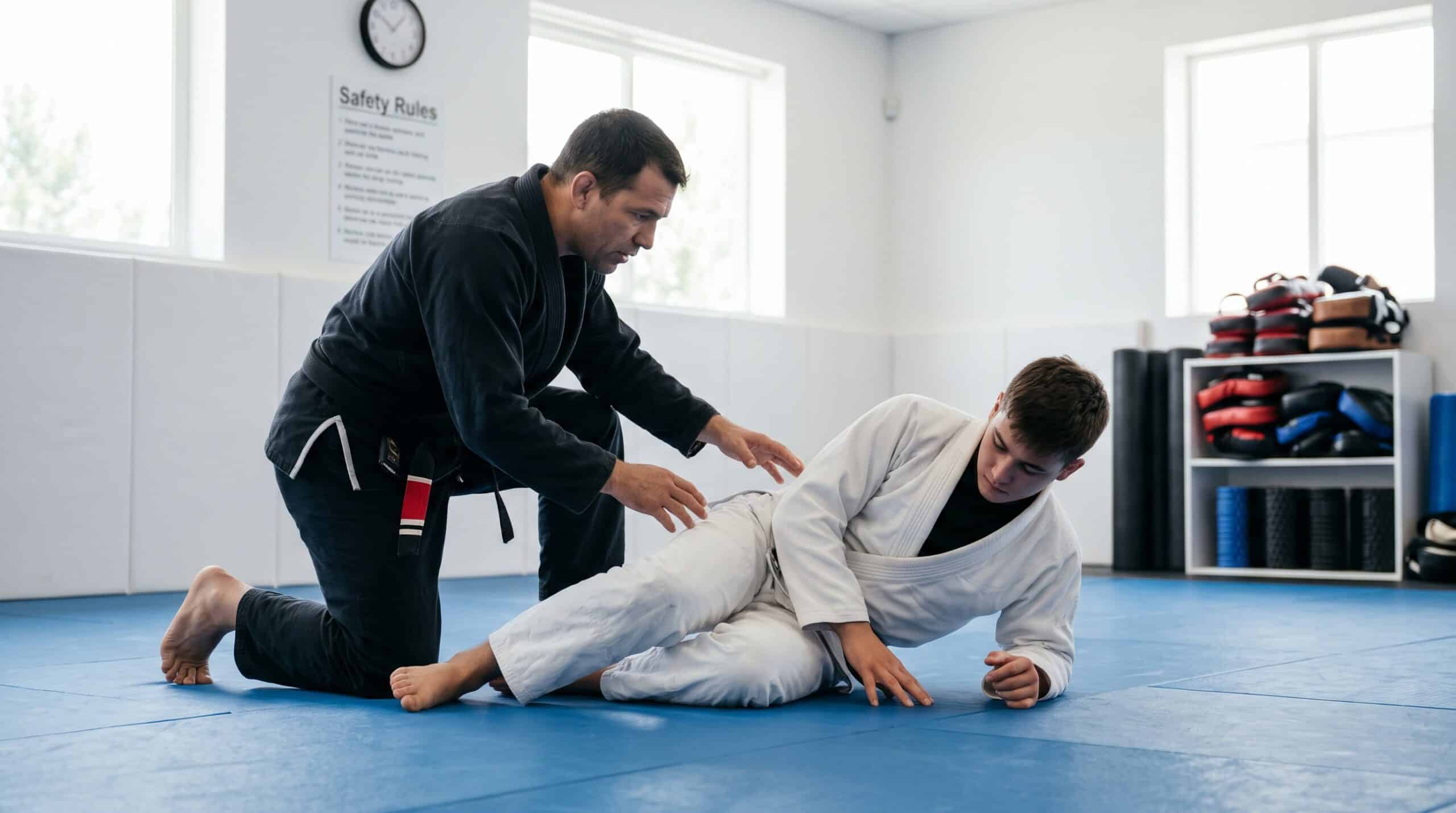
BJJ private lessons are one-on-one or small group sessions where a coach builds the hour around one student’s game, usually mixing a short warm-up, focused drilling on a problem position and controlled positional rolling. For the coach, a good private has a plan, a set intensity, a safe place to train and clear booking terms, because privates happen with less supervision and in more places than a normal class.
Privates are where many coaches earn real money and where students fix the holes a group class can’t reach. They also carry their own risk: one partner who is also the teacher, mats in garages, and kids alone with an adult. This guide covers how to run them well and how to keep them safe.
What are BJJ private lessons?
BJJ private lessons are paid sessions where a Brazilian jiu-jitsu coach teaches one student, or a small group, outside the regular class schedule. The coach picks positions and techniques for that student’s goals, drills them with live feedback, and controls how much resistance the student faces. Sessions usually run about an hour.
Jiu jitsu private lessons can happen at the academy, on home mats, in a garage or at a student’s house. The location changes the risk more than the curriculum does.
Are BJJ privates worth it?
For most students, yes, if the private has a clear goal. A student stuck in one position for months often fixes it faster with focused reps and direct correction than with more group classes.
Privates help most when a student:
- Is new and wants to catch up on basics before rolling with the class
- Keeps getting stuck in the same spot, like bottom side control or a closed guard they can’t open
- Is coming back from time off or working around an old injury
- Is nervous in a crowded room and learns better one-on-one
They help least when the student treats them as a hard roll with a black belt. That’s a fun hour, and a poor use of the time.
How to teach BJJ privates: what does a good one look like?
A good private has a plan before the student arrives. Ask what they want to work on, check how their body feels, and build the hour around one problem.
| Segment | What happens | Why it matters |
|---|---|---|
| Check-in | Goals, recent injuries, how they feel today | Sets intensity and flags anything to avoid |
| Warm-up | Shrimping, bridging, light grip work | Cuts strains in the first live minutes |
| Technique | One position, two or three options, many reps | Focus beats volume |
| Positional drilling | Start in the position, add resistance in steps | Builds timing without a full roll |
| Controlled rolling | Short rounds at a set pace | Tests the technique under pressure |
| Review | Recap, notes, what to drill next | Gives the student homework and you a record |
Keep short notes after every private: what you taught, how hard you rolled and anything the student told you about injuries. Those notes help the next session and protect you if a question comes up later. Coaches who keep learning teach better privates, and continuing education also builds student trust.
How hard should you roll in a private?
Lighter than you think. In a private you are both the coach and the only training partner, so the student’s safety rests on your control.
Set the pace out loud before each round: flow, positional or harder resistance. Let the student work. Apply submissions slowly and let them tap. Don’t hit fast leg locks or slams, even if the student asks for “the real thing.” A student hurt by their coach in a private has an easy story to tell: the expert was in charge of the intensity. Questions about who is responsible go deeper in our post on whether you’re personally liable as a jiu-jitsu instructor.
If a student gets hurt, stop, give first aid and tell them to see a doctor. Call emergency services for any head, neck or spine injury.
Where can you teach privates: academy, home mats or a garage?
The academy is the safest place for privates. Home mats, garages and a student’s house work, but each one shifts more risk onto you.
- At the academy. Good mats, padded walls, a first aid kit and other people nearby. Get the owner’s written okay, and ask whether the academy’s policy covers privates taught by coaches who aren’t employees.
- On your home mats or in your garage. Check for gaps between mats, hard edges, low ceilings, tools and parked cars. A homeowner’s policy often limits or excludes business activity at home, so read up on working from home and your insurance and ask your agent.
- At a student’s house. You don’t control the space. Walk it first and move furniture away from the mats. If you bring mats, a floater for equipment that travels with you is worth asking about.
Keep mats clean wherever you teach. Disinfect before and after each private, and skip the session if either of you has a skin issue like ringworm. Simple skin infection habits apply one-on-one too.
How should you handle kids privates?
Run kids privates with a parent or a second adult in the room, every time. A one-on-one private with a child behind a closed door is the setup most abuse allegations start from, true or false.
- Keep doors open and windows uncovered. A parent watching from the side is ideal.
- Talk to parents, not directly to the child, about scheduling and texts.
- Ask before any hands-on adjustment and explain it out loud.
- Keep intensity low and positions age-appropriate. No neck cranks or joint locks beyond the child’s level.
- Run background checks on any assistant who teaches kids privates for you.
Then confirm your coverage includes abuse and molestation coverage. Most general liability policies exclude abuse claims, so it usually has to be added.
What booking and cancellation terms should privates have?
Simple written terms, agreed before the first session. They stop most arguments before they start.
Cover these in plain words: how to book, how far ahead a student must cancel, whether a late cancel counts as a used session, whether packages expire, and what happens if you cancel. Add a signed waiver for anyone not already on file at the academy. A waiver is one layer: it helps show the student accepted known risks, a legal idea called assumption of risk, but it won’t cover everything. Have a local attorney review your terms and your waiver.
Who pays if a student gets hurt in a private lesson?
Usually a liability policy pays for the defense and any covered settlement, but whose policy depends on who you teach for. An employee teaching at the academy is usually under the academy’s policy. An independent coach usually needs their own.
- Professional liability covers claims that your instruction caused harm: the pace you set, the technique you chose, the way you applied a submission. In a private, that’s the main exposure. See how it compares with general liability.
- General liability covers injuries tied to the space: a mat gap, a hard edge, a slip on a wet garage floor.
- Abuse and molestation coverage responds to abuse allegations involving a student.
What usually doesn’t respond:
- The academy’s policy, when you’re independent. Teaching privates on someone else’s mats as a contractor often falls outside it.
- Your homeowner’s policy. Business activity at home is often excluded.
- Tournaments. Coaching a student at a competition is outside what a private lesson covers.
- Your own injuries. Those fall to your health insurance.
Academies often want independent coaches to send a certificate of insurance and name the academy as an additional insured before they teach on the mats. Open mats run the same way: if you coach during one, the rules in our post on open mat exposure apply.
How NEXO Insurance Services fits coaches who teach privates
The right setup covers your coaching judgment and the space, follows you to every location, and gets certificates to academies fast.
NEXO Insurance Services has insured over 20,000 fitness professionals since 2005. For independent coaches, NEXO offers Alternative Balance, its program for independent trainers and instructors, with same-day certificates of insurance. Ask NEXO whether Alternative Balance fits the way you teach privates, including home mats and student homes. For academy owners, NEXO’s facility program writes general liability, professional liability, participant accident and abuse and molestation coverage, and NEXO offers background checks and free injury reporting. NEXO does not cover tournaments or other martial arts events. See NEXO’s jiu-jitsu gym insurance page for academy coverage.
The bottom line on BJJ private lessons
BJJ private lessons work best with a plan, a set pace and a safe space. Keep notes, put a second adult in every kids private, and write down your booking terms. Then make sure a policy covers you wherever you teach, whether it’s the academy’s or your own.
BJJ private lessons FAQ
How long are BJJ private lessons? Most run about an hour. That’s enough time for a check-in, a warm-up, one focused technique, positional drilling and a short controlled roll.
Are BJJ privates worth it for beginners? Often, yes. Beginners can learn safe basics, tapping and positions before rolling with the class, which makes group training safer.
Can I teach jiu jitsu private lessons in my garage? You can, but check the space carefully and ask your agent, since many homeowner’s policies limit or exclude business activity at home.
Does the academy’s insurance cover me when I teach privates there? It may cover employees, depending on the wording. Independent coaches usually need their own policy, which NEXO Insurance Services offers through Alternative Balance.
Should a parent stay for a kids private? Yes. Keep a parent or second adult in the room for every kids private, with doors open and communication going through parents.
Do I need a certificate of insurance to teach privates at another academy? Usually. Many academies ask independent coaches for a certificate before they teach, and NEXO Insurance Services issues same-day certificates through Alternative Balance.
How hard should a coach roll in a private? Lighter than in open training. Set the pace out loud, let the student work, and apply submissions slowly so they can tap.
Recent Posts
 November 5, 2026