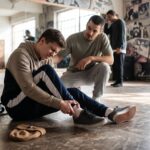
Most ballroom dance injuries are ankle sprains, knee strain, lower back pain, shoulder and neck strain, and falls on the dance floor. They usually come from partner work (dips, drops and lifts), heels on slick floors, and crowded social nights where couples collide.
This guide is for ballroom, Latin and salsa studio owners and instructors. It covers where injuries come from, how to run partner work and socials safely, and which coverage usually responds when a student gets hurt. It’s about risk, not medical advice. Anyone hurt on the floor should see a doctor.
What are ballroom dance injuries?
Ballroom dance injuries are the sprains, strains, overuse problems and falls that happen in partner dancing. They often affect the ankles, knees, hips, lower back, neck and shoulders. Some build slowly from repeated frame, posture and footwork. Others happen in one moment, like a missed dip, a heel catching the floor, or a collision on a busy social night.
Ballroom dance covers smooth and standard styles like waltz and foxtrot, and Latin and rhythm styles like cha cha, rumba and samba. Salsa, bachata and swing share the same partner risks. Research on competitive dancers shows injuries cluster in the lower body and spine, which matches what instructors see in class.
Where do ballroom and Latin injuries come from?
Most come from four places: partner work, footwear and floors, repetition, and crowding. The studio controls more of each than students think.
Partner work
Two bodies move as one, so one mistake can hurt both. A leader who yanks a follower into a turn can strain a shoulder. A follower who drops weight into a dip the leader isn’t ready for can wrench the leader’s back.
Heels and floors
Followers often dance in heeled shoes. Add a slick or sticky spot and an ankle rolls. Ankle injuries are among the most common problems in ballroom and Latin classes.
Repetition and posture
Holding a lifted frame and an arched upper back for hours wears on the neck and lower back. Latin hip action and pivots repeat the same load on knees and hips.
Crowds
A social night puts dozens of couples on one floor, all moving in different directions. Kicks, elbows and back-to-back collisions are common.
How do you keep dips and lifts safe?
Teach dips and lifts in steps, match partners by size and skill, and keep them out of crowded socials. Dance partner lift safety starts with the rule that no one attempts a lift they haven’t learned in class with a spotter.
- Teach the base first. Leaders learn to keep their back straight and bend at the knees. Followers learn to keep their core engaged and support their own weight.
- Start low. Teach a small supported dip before a deep drop. Teach lifts with feet close to the floor before anything overhead.
- Spot new lifts. An instructor or trained assistant stands close for every first attempt.
- Match partners. Pair by size, strength and experience, and let any student say no to a lift.
- Ask before touch. Instructors who demonstrate with students should ask first. Read more on hands-on correction risk.
- No lifts on social nights. Post the rule. Social floors are too crowded for aerials and big drops.
How do you prevent salsa injuries and spin strain?
Most salsa injuries come from fast spins, aggressive leads and arms pulled out of line. Teach leaders to guide turns through the hand, not by yanking the arm, and teach followers to keep elbows in front of the body.
Build spin speed slowly. Teach spotting the head to cut dizziness. Warn students about dancing in new shoes or on a floor they don’t know. Shoulder and wrist strain usually shows up when a leader cranks a follower through multiple turns. Correct it in class before it shows up on a social floor.
What causes dance floor falls, and how do you prevent them?
Dance floor falls usually come from wet or sticky spots, loose boards, worn finish, the wrong shoes and crowding. A daily floor check and clear shoe rules prevent most of them.
Use this checklist before every class and social:
| Check | What to look for | Fix |
|---|---|---|
| Surface | Spills, sticky spots, worn finish | Clean, dry, and close the spot until fixed |
| Edges and seams | Raised boards, loose tape, gaps | Repair or tape flat, report to the landlord in writing |
| Shoes | Street shoes with grit, rubber soles that grip | Dance shoes or approved soles only |
| Lighting | Dim corners during socials | Keep floor edges lit |
| Space | Tables, chairs and bags near the floor | Clear a buffer zone around the floor |
| Drinks | Cups near the dance floor | Keep drinks off the floor area |
| Exits | Blocked doors and walkways | Keep exits clear and marked |
Common claims against fitness businesses often start with a slip or trip that a five-minute check would have caught.
How should you teach older adult students?
Many ballroom students are older adults, so build in balance work, slower progressions and an easy way to sit out. Falls carry more risk for older adults, and fall prevention starts with balance, strength and a safe floor.
Ask about health conditions on the intake form. Offer smaller dips or none. Keep chairs at the floor’s edge. Ask students with heart conditions, joint replacements or balance problems to check with their doctor before starting, and teach to any limits they give you. More on safety for older students applies here too.
How do you keep social dance nights safe?
Social dance safety comes down to floor rules, crowd control and alcohol. Post the rules, put a staff member in charge, and keep alcohol separate from the dance floor.
- Post floor etiquette. Travel in the line of dance, keep moves small on a busy floor, no lifts or aerials.
- Assign a host. One staff member watches the floor and can stop anyone dancing unsafely.
- Set capacity. Know how many people the room holds safely and stop letting people in.
- Get waivers from guests. Drop-ins and guests should sign at the door.
- Plan for alcohol. Serving or allowing alcohol raises the risk of falls and fights.
Alcohol is its own insurance question. Liquor liability covers claims tied to serving alcohol, like an intoxicated guest who falls or drives. General liability policies usually limit or exclude it, and host liquor liability is often narrow. Liquor liability is separate coverage, and NEXO can arrange it through a carrier partner. A large outside event may also need special events coverage.
Who pays when a student gets hurt?
It depends on what caused the injury and the policy wording. A fall on a damaged floor usually goes to general liability. A claim that an instructor taught a dip unsafely usually goes to professional liability. A student’s medical bills can be paid by participant accident coverage without anyone proving fault.
- General liability covers bodily injury and property damage to other people tied to your space or classes. Slips, trips and collisions on the floor land here.
- Professional liability covers claims that instruction caused harm, like a back injury from a lift taught too early. See the difference between general and professional liability.
- Participant accident coverage pays a hurt student’s medical bills, usually after their own health insurance. Quick payment often stops a lawsuit. Read what participant accident insurance does.
- Workers’ comp covers your employees, like an instructor who strains a back demonstrating a dip.
What usually doesn’t respond: alcohol-related claims without liquor liability, independent instructors who rent your floor without their own policy (see renting to independent instructors), and off-site socials you never disclosed. If you run socials in a rented hall, the venue may ask to be named an additional insured. For class injuries in detail, read what studio policies cover in class. Ask your agent how your policy responds.
What should you do after a fall or injury?
Stop the music, help the student, and write it down the same day.
- Give first aid. For any head, neck or hip injury in an older student, don’t move them and call emergency services.
- Tell them to see a doctor. Even if they say they’re fine.
- Write an incident report. Note the floor, shoes, partner, move and witnesses. A free injury reporting tool helps.
- Report it to your insurer early, before any claim.
- Follow up. Check in, and don’t argue about fault.
Build these steps into your instructor safety guidelines so every teacher knows them.
How NEXO covers ballroom and Latin studios
Ballroom and Latin studios need coverage for the floor, the teaching, student injuries and social nights.
NEXO Insurance Services has insured over 20,000 fitness professionals since 2005. Through its facility program for dance studios, NEXO writes general liability, professional liability and participant accident coverage, plus property coverage for studios and equipment and workers’ comp in 46 states. NEXO also offers same-day certificates of insurance for venues and free injury reporting. If you serve alcohol at socials, NEXO can arrange liquor liability through a carrier partner. See NEXO’s dance studio insurance options.
The bottom line on ballroom dance injuries
Ballroom dance injuries mostly come from partner work, heels, slick floors and crowded socials. Teach dips and lifts in steps, check the floor every day, adapt for older students and post social night rules. Carry coverage that fits partner dancing, and treat alcohol as a separate risk.
Ballroom dance injuries FAQ
What are the most common ballroom dance injuries? Ankle sprains, knee strain, lower back pain, shoulder and neck strain, and falls are the most common. Most come from partner work, heels and slick or crowded floors.
Are dips and lifts safe in social dancing? Small, controlled dips can be safe between experienced partners. Lifts and big drops belong in class with a spotter, not on a crowded social floor.
How do salsa injuries usually happen? Most come from fast spins and leaders pulling arms out of line. Teaching leads through the hand and keeping elbows in front of the body prevents many of them.
Who is liable if a student falls on a studio dance floor? The studio can be blamed if the fall came from a hazard it should have fixed, like a spill or loose board. General liability usually responds, depending on the policy wording.
Does a dance studio policy cover alcohol at social nights? Usually not on its own, because liquor liability is separate coverage. NEXO Insurance Services can arrange liquor liability through a carrier partner.
Do older ballroom students need a doctor’s clearance? Students with heart conditions, joint replacements or balance problems should check with their doctor before starting. Use an intake form and teach to any limits they give you.
How can a ballroom studio pay a student’s medical bills without a lawsuit? Participant accident coverage pays medical bills no matter who was at fault, usually after the student’s own health insurance. NEXO Insurance Services offers it through its dance studio facility program.
Read MoreRecent Posts
 October 30, 2026